

New data from United For ALICE reveals that 41% of Oregon households still can't afford the basics — even as unemployment stays low and the economy keeps growing. This is the hidden face of hardship in our state.
What Does ALICE Mean?
Asset Limited, Income Constrained, Employed - No savings or financial cushion. One unexpected expense — a car repair, a medical bill — can unravel everything. Earning above the federal poverty line, but not enough to actually afford the cost of living in their community. Income is stretched to the breaking point — deciding between rent and groceries, between childcare and a prescription. The cost of survival — housing, food, childcare, transportation, healthcare — keeps rising faster than wages can follow. These are working people — contributing to their communities and doing everything right. The system is failing them, not the other way around.
Support our Resilient Families Fund
Ensuring our community can stay resilient despite the many forces pushing against them requires a commitment from us all. Join us today with a donation to our Resilient Families Fund, a flexible, fast fund designed to stop instability before it spirals.
This fund allows our organizations to step in when a family or individual is facing eviction, an unpaid utility bill, a car repair, or other unexpected expenses that can push ALICE families into a financial free fall.
They're Our Neighbors. Our Coworkers. Our Community.
ALICE households earn more than the federal poverty level — so they're often invisible to the support systems designed to help struggling families. But they don't earn enough to cover the true cost of housing, childcare, food, transportation, and healthcare in Oregon today.
These are the people who keep Oregon running every single day. And they are one unexpected crisis — a medical bill, a rent increase, a job disruption — away from losing stable housing and tipping into homelessness.
That's not a personal failure. That's a structural gap between what work pays and what survival costs.
The Numbers Behind the Story
The 2026 ALICE Report draws on 2024 American Community Survey data to paint the most complete picture yet of financial hardship across Oregon.
41%
Below the ALICE Threshold
of Oregon households — including those in poverty (12%) and working ALICE families (29%) — cannot afford the basics
714K
Households in Hardship
Oregon households living below the ALICE Threshold, facing impossible trade-offs between food, prescriptions, rent, and childcare
$91,500
Family Survival Budget
the bare-minimum annual income a family of four needs to cover the basics in Oregon — up from $88,000, and nearly 3× the federal poverty line
94%
Of Oregon Counties
where $20 an hour is no longer enough to support a single parent with one school-age child
"These are families who are working, contributing to their communities, and doing everything right — yet still struggling to keep up with the rising cost of living."
Kelly O'Lague · President & CEO, United Way of the Columbia-Willamette
The Invisible Gap
The Poverty Line No Longer Tells the Whole Story
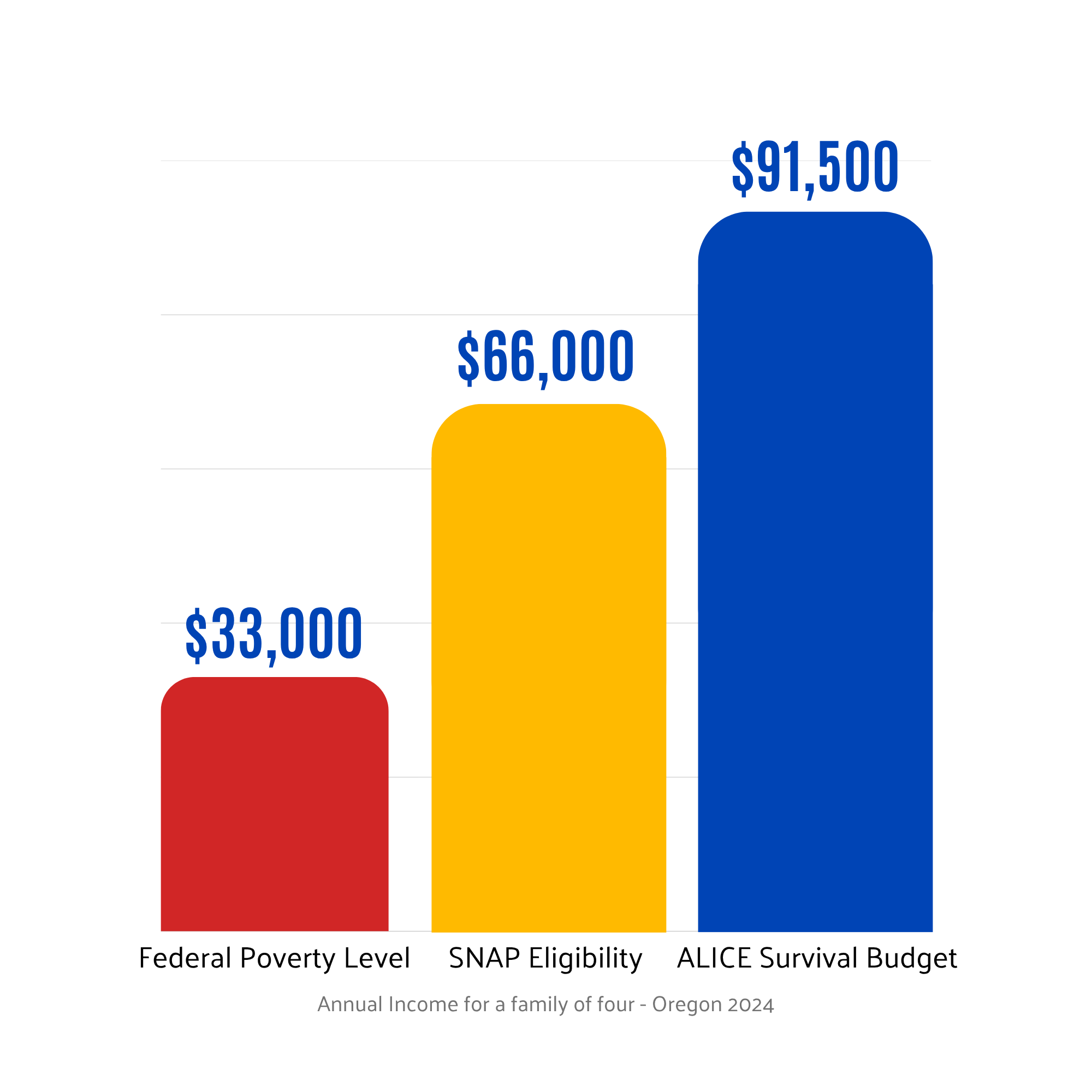
The Federal Poverty Level for a family of four is $33,000 — a number that hasn't kept pace with reality. An Oregon family needs nearly three times that amount — $91,500 a year — just to afford housing, food, childcare, transportation, and healthcare.
Even Oregon's more generous benefit thresholds fall short. SNAP eligibility extends to 200% of FPL — around $66,000 — yet Oregon families still fall short of what it actually costs to get by.
While a minor dip in ALICE household counts occurred between 2022 and 2024, the long-term structural trajectory is clear: working-class hardship is growing far faster than traditional measures show.
44%
of full-time Oregon workers don't earn enough to support a single-adult, single-child household
Working Full-Time Is No Longer Enough
The ALICE Essentials Index — which tracks the real cost of rent, childcare, basic groceries, and fuel — has risen at a significantly faster rate than the broad Consumer Price Index since 2007. The things ALICE families can't live without are getting more expensive faster than wages are rising.
- $20/hour is not enough: in 94% of Oregon counties to support a single parent with one school-age child.
- Racial disparities persist: 46% of households of two or more races fall below the ALICE Threshold, compared to 40% of White, non-Hispanic households.
- Benefits fall short: Even SNAP eligibility at 200% FPL ($66,000) leaves Oregon families roughly $33,000 short of the actual ALICE survival budget.
- Inflation hits harder: Cost increases for uncompromisable survival needs — rent, childcare, groceries, fuel — have outpaced national price increases since 2007.